Apologeet.nl
Baptised but not born again? The question that divides Reformed churchesThe Differences Between the Dutch Reformed Congregations, CGK, HHK, PKN and Other Reformed Churches
Two churches less than a kilometre apart. Both sing psalms, both read the Dutch Bible translation the Statenvertaling, both believe in the Trinity, in the sinfulness of humanity and in salvation through Jesus Christ alone. And yet their members worship separately. This is where the difference lies. One church says: if you have been baptised, you belong. God has made His covenant with you. That is the basis of your assurance. The other church says: hang on a moment. Have you truly been born again? Because it is possible to believe everything, know everything, understand everything — and yet never have experienced grace in your heart. “You recognise the tree by its fruit.” One says: loving God is Jesus’ command, and whoever loves Him also loves Him. The other says: but do you know that? Do you have that assurance in your heart? “Whoever believes in the Son has eternal life” — but do you? Who is right? If you do not come from a Reformed church, all of this can be rather confusing.
You have the Reformed Congregations. The Restored Reformed Church. The Christian Reformed Churches. Four or five congregations within a few kilometres of one another, and yet every church service sounds different. Why? Over the past while, I have been increasingly studying the Dutch Reformed traditions. And the deeper you go into it, the more interesting it becomes.
Because it is not simply about different church buildings or different names. There are historical and theological differences behind them. And some of the words that are perfectly ordinary within these churches can sound rather complicated to outsiders. Words such as spiritual experience, regeneration, election, covenant and the offer of grace. So I am going to explain those along the way as well.
Let that sink in for a moment: two churches, the same Bible, the same confession — and yet a different gospel emphasis. Why? So let us begin at the beginning.
FIRST: WHAT DO THEY ALL HAVE IN COMMON?
Before we look at the differences, we must not forget one thing. These churches have an enormous amount in common. Many of these churches stand within the Reformed confessional tradition, with documents such as the Belgic Confession, the Heidelberg Catechism and the Canons of Dort. The latter are the three well-known Reformed confessional documents that are often collectively referred to as the Three Forms of Unity. A confessional church is, very simply put, a church that officially regards itself as bound to an established confession of faith.
And within that Reformed confession we find, for example, the doctrine of the Trinity. Humanity has been alienated from God through sin. We cannot save ourselves. Jesus Christ is the only basis of our salvation. And salvation is ultimately grace. So if you look from the outside at, for example, the Reformed Congregations, the CGK and the Dutch Reformed Churches, you might think: “But hang on… don’t they basically believe the same thing?”
Well… To a large extent, yes. But the differences often lie in the way certain truths are understood, connected and, above all, applied pastorally. And for that, we need to go back into history.
HOW DID THIS FAMILY BECOME SO DIVIDED?
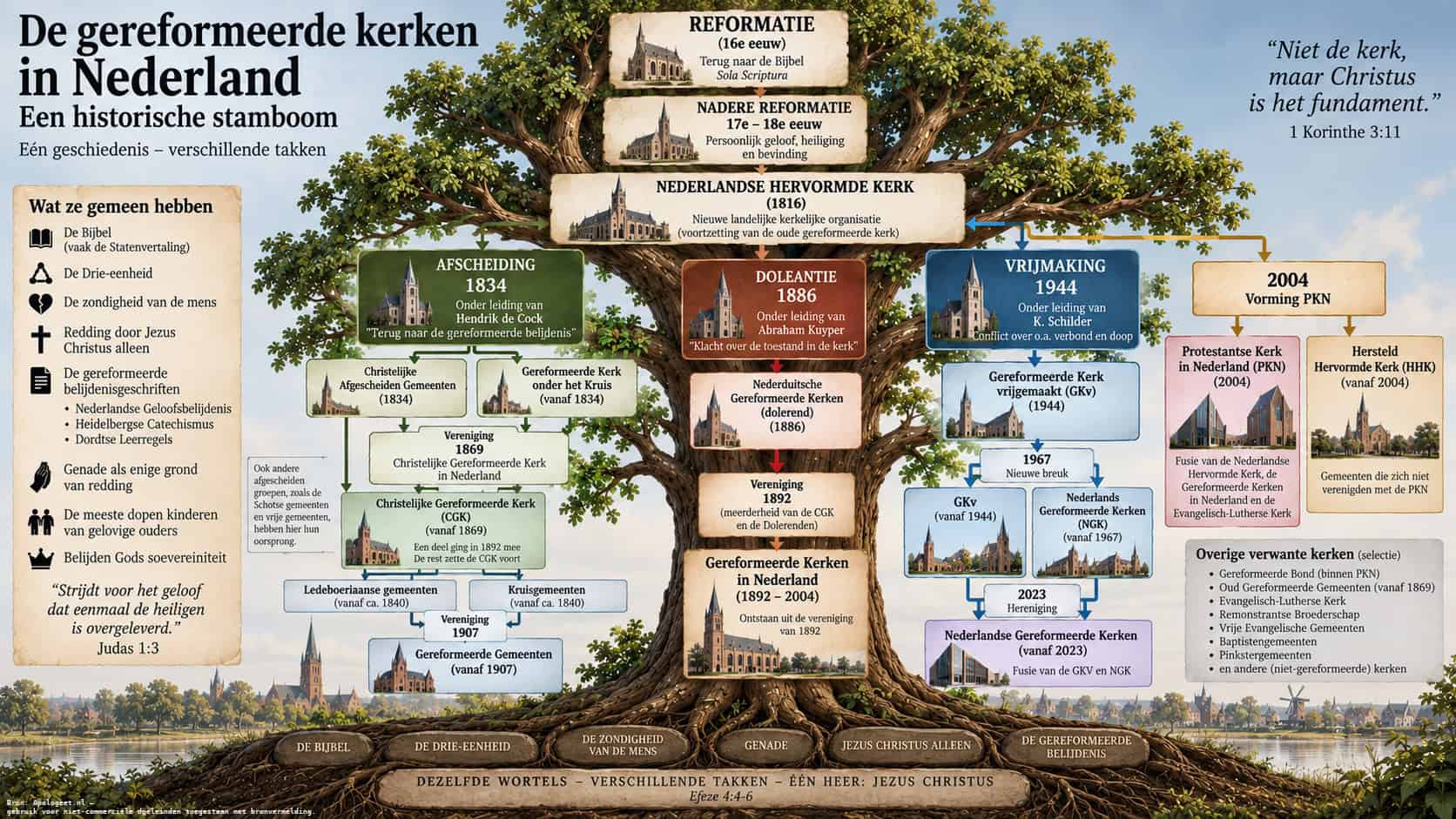
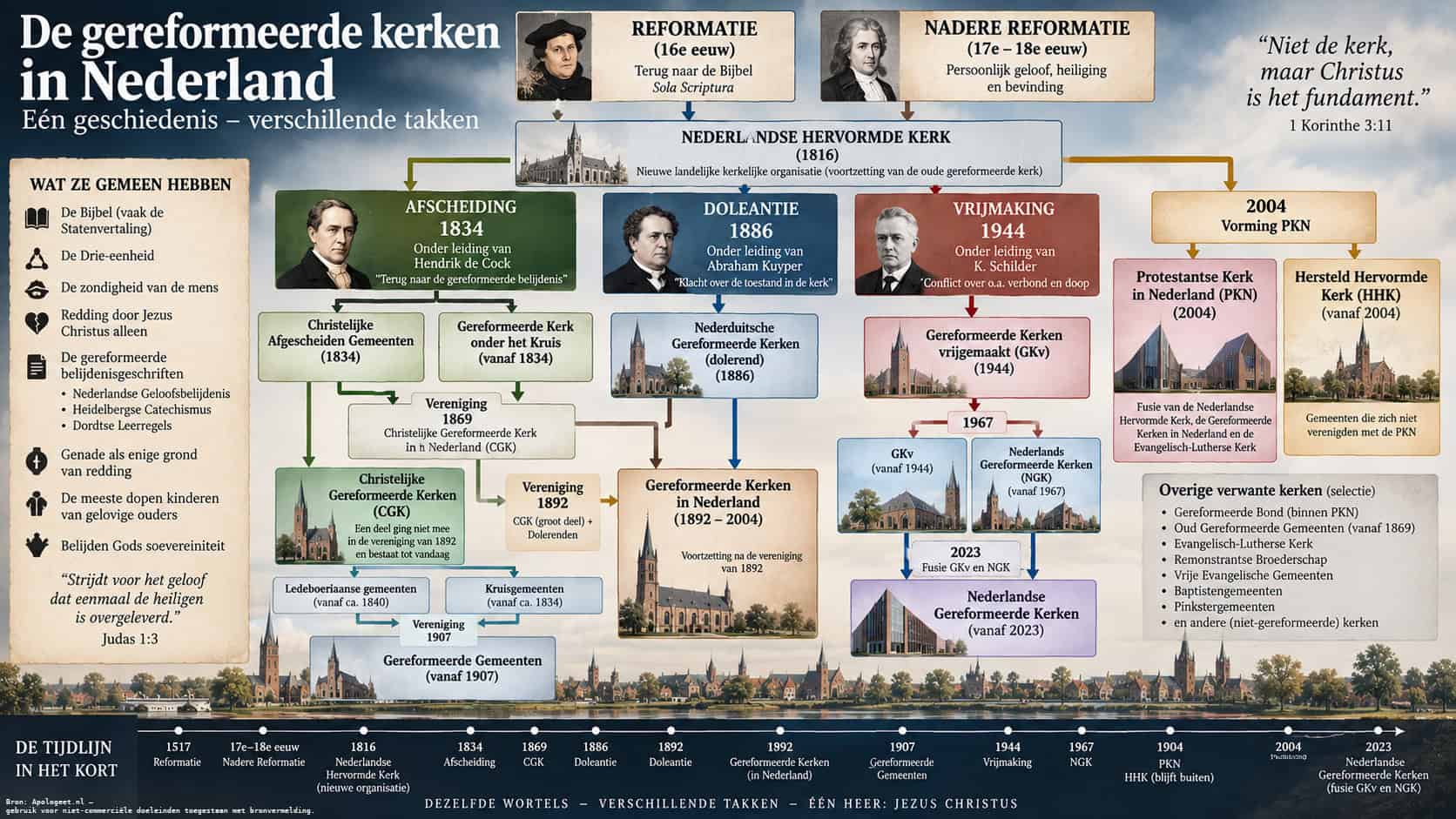
Dutch Reformed church history is really a kind of family history. The Reformation brought a Reformed church into being in the Netherlands. After that, all kinds of developments took place within that Reformed tradition. One of them was the Further Reformation. This was a movement within Dutch Reformed Protestantism that strongly emphasised that faith should not merely be something you confess with your mind. Reformed doctrine also had to become a personal reality in your life. So not merely: “I believe that humanity is sinful.” But: “Do I know my own sin?” Not merely: “Christ is the Saviour.” But: “Do I actually trust in Christ?” Not merely: “The Holy Spirit works in people.” But: “What does the work of the Holy Spirit mean in my own heart?” And that emphasis on personally experiencing and living out the faith would later become very important to what we now call the experiential Reformed tradition.
Meanwhile, history continued to unfold. In 1834 came the Secession.
Christians and ministers left the Dutch Reformed Church because they believed that the church was not sufficiently maintaining its Reformed identity and confession. New church denominations emerged from this. Later, in 1886, came the Doleantie, another split within the Dutch Reformed Church.
The word Doleantie comes from the Latin dolere and means something like ‘to lament’ or ‘to suffer’. Under the leadership of Abraham Kuyper, Reformed Christians again separated from the Dutch Reformed Church because they believed that the church was not sufficiently maintaining its Reformed confession.” Together with other developments, this led to the formation of the Reformed Churches.
And then, in the twentieth century, further divisions followed. And that is ultimately where the church denominations we know today come from. So when someone says: “Why are there so many Reformed churches? Don’t they all believe the same thing?”
The answer is: it was not one single split. It is a history of different movements, church conflicts, theological debates and different emphases that have developed over almost five centuries. And once you understand that, the differences we see today become much easier to understand.
THE REFORMED TRADITION WITHIN THE DUTCH REFORMED CHURCH
Let us begin with the Dutch Reformed tradition. In 2004, the Dutch Reformed Church became part of the Protestant Church in the Netherlands, the PKN. But if you say: “This is what the PKN believes,” you need to be careful straight away. The PKN is a very broad denomination. You find liberal congregations, moderate orthodox congregations, confessional congregations and also strongly Dutch Reformed congregations. So two PKN congregations can differ considerably theologically.
Within the Dutch Reformed tradition, there is a strong emphasis on the Reformed confession and on preaching sin and grace. And here we encounter another important word: spiritual experience. In this context, it does not simply mean that you have a particular feeling about something. It means personally experiencing and living out what you confess from God’s Word. So if you say: “I believe that Christ saves sinners,” the question then becomes: “But do I myself trust in Christ?”
In practice, this means that on Sunday the question is not only what you believe, but also how that faith has become a reality in your own heart. Personal faith and the reality of God’s grace in the heart are therefore important themes within this tradition. But that does not yet cover all the Reformed churches.
For although the various churches have much in common, they do not all place exactly the same emphasis on things. And this becomes clear when we look at the Christian Reformed Churches.
THE CHRISTIAN REFORMED CHURCHES
Then we come to the Christian Reformed Churches, the CGK. The CGK emerged from the history of the Secession of 1834 and are therefore deeply rooted in the Reformed tradition. But if you want to know what the CGK are like theologically, you immediately encounter a problem: there is not just one type of CGK congregation. There are quite significant differences in emphasis within the CGK. Some congregations are strongly experiential Reformed, while others have a more confessional-Reformed or evangelical emphasis.
As a result, one CGK congregation can feel quite different in practice from another CGK congregation. And that is important to bear in mind when considering virtually all the denominations we discuss in this video.
A denomination is not automatically one homogeneous group in which every congregation and every minister thinks exactly the same way.
THE REFORMED CONGREGATIONS
And then we come to a denomination in which the experiential aspect probably comes even more strongly to the fore: the Reformed Congregations, also known as the GerGem. The Reformed Congregations stand strongly within the tradition of the Further Reformation. And as a result, there is a strong emphasis on the personal experience of God’s grace. But what does that actually mean? Suppose someone says: “I believe in Jesus.” Within an experiential tradition, the next question might be: “But how did you come to know that faith? What has God done in your life? How did you come to know your sin? How were you brought to Christ?” This brings us to another important word: regeneration.
In Reformed theology, regeneration means that the Holy Spirit makes a person spiritually alive.
If you want to explore the subject of regeneration in greater depth, I have also made a separate video about it: The ONE sign that shows someone has NEVER been born again. In that video, I go into greater depth on how the work of regeneration becomes visible in someone’s life.
So it is about God’s work in the heart of a person. Ultimately, a person cannot bring themselves to spiritual life. God must renew them. And that connects again with election. Election is the Reformed doctrine that God, by grace, chooses people for salvation. This is not a side issue within Reformed theology. It goes directly to the question of where our salvation ultimately begins. But this is also where a difference in emphasis emerges. All classical Reformed churches confess election. So the question is not: “Does one church believe in election while another does not?” That would be far too simplistic. The question is rather: “What place does election have in preaching? How is it connected with calling, faith and the assurance of the believer?” And it is precisely here that the emphases can differ considerably.
I have already made an entire video on my channel about precisely this tension between God’s sovereignty, human responsibility and the role of the Holy Spirit. It is called Calvinism versus Arminianism: The Forgotten Role of the Holy Spirit. If you want to explore this more deeply, I would certainly recommend watching that video as well.
BUT CAN YOU ACTUALLY BE SURE?
And this brings us to one of the most interesting differences. Assurance. Can a Christian say: “I know that I belong to Christ?” The Reformed tradition certainly does not speak about this in exactly the same way everywhere. The Reformed confessions themselves speak about the assurance of faith. But in experiential Reformed traditions there is often also a great deal of attention given to the question of whether someone truly possesses faith. Not merely: “Do I believe that Christ exists?” but: “Is my faith truly faith in Christ?” And how do I know? In this context, characteristics of spiritual life can play an important role. For example, repentance over sin, a desire for God, love for Christ and a life in which the fruit of faith becomes visible. But here we need to avoid a caricature. It is not accurate to say: “In the Reformed Congregations you are never allowed to know whether you are saved.” That is not a fair representation. The difference lies much more in the question of what assurance is based upon and how someone comes to that assurance. These are much deeper questions than simply saying: “This church believes in assurance and that church does not.” But I believe there is a text that can be heard in all Reformed churches. Scripture says in Hebrews 10:22
Hebrews 10:22
let us draw near with a true heart in full assurance of faith
It is precisely God’s promise that is the foundation of your assurance. Not your fruit first, not your spiritual experience first, but His Word first. And therefore the question “Can I really know that I belong to Christ?” is not a question you need to leave hanging in uncertainty — your assurance may rest upon Him who is faithful.
I have noticed that quite a lot of Christians struggle with doubts about their salvation. If you are struggling with that yourself, you can watch my video AM I REALLY SAVED? after this video. There I go much deeper into the question of what you may actually base the assurance of your salvation upon.
THE RESTORED REFORMED CHURCH
Then we come to the Restored Reformed Church, the HHK. This church arose around the formation of the Protestant Church in the Netherlands in 2004. Some Dutch Reformed congregations and church members could not agree with the formation of the PKN and remained outside that new denomination. From this the Restored Reformed Church emerged. And this immediately shows something important: not every church split happens because people suddenly have a completely different theology.
Sometimes it is also about the question: “What is happening to our church? Which church identity are we preserving? And with which church do we want to be connected?” Theologically, the HHK clearly stands within the Reformed confessional tradition.
There are also strong similarities within the HHK with other experiential Reformed churches. But here too there is internal diversity. So even with the HHK, you need to be careful with simple labels.
FROM GKV TO NGK
Then we come to another branch of the Reformed family: the churches that emerged from the Liberation of 1944. That name can be confusing, because this was not a liberation movement during the Second World War. The Liberation did take place during the German occupation, but the cause was an internal church conflict concerning, among other things, the meaning of the covenant and baptism. Among other things, this led to the Reformed Churches (Liberated), the GKV.
Later, the Dutch Reformed Churches, the NGK, also emerged. Eventually, the GKV and NGK merged in 2023 into the present-day Dutch Reformed Churches. These churches are also Reformed and confessional.
But the way themes such as covenant, faith, assurance, church and culture are discussed can differ from, for example, the Reformed Congregations. And here we come once again to an important word: covenant.
In Reformed theology, the covenant is God’s covenant relationship with His people. And it is precisely around the covenant that all kinds of important questions arise. For example: What does it mean that children of believing parents are baptised? What does baptism say about God’s promise? How does that promise relate to personal faith? And how does the covenant relate to election? These are questions on which Reformed churches sometimes place different emphases.
INFANT BAPTISM
And this naturally brings us to infant baptism. Most classical Dutch Reformed churches baptise children of believing parents. But here too, it is important not to think: “Everyone means exactly the same thing by that baptism.”
The differences lie, for example, in how the covenant is understood and how the relationship between God’s promise, baptism, faith and regeneration is described. Why is a child baptised? What does it mean that God gives His covenant and promises to the congregation? What may a baptised child personally conclude from this? And how does baptism relate to the question of whether someone is actually united with Christ through faith? These are important questions.
And it is precisely here that you can see how the different parts of Reformed theology are interconnected. You cannot really discuss infant baptism entirely separately from your view of the covenant. And you cannot separate the covenant entirely from your view of election, faith and regeneration.
SO WHERE DO THE REAL DIFFERENCES LIE?
If you put everything we have discussed together, you see a number of recurring themes. The first is election. Virtually all classical Reformed churches confess God’s electing grace. But the question is how that election functions in preaching. Is it primarily discussed as comfort for the believer? How is it connected with the call to faith? And how do you prevent someone from thinking: “I first need to know whether I am elect before I am allowed to come to Christ?” That is an important question. The second theme is regeneration. Every Reformed church will say that a person needs God’s grace and that the Holy Spirit works new life. But there can be differences in how the relationship between regeneration, faith, conversion and consciously coming to know Christ is described. The third theme is assurance. What may a Christian build their assurance upon? God’s promise? The faith by which they embrace Christ? The fruits of faith? The work of the Holy Spirit? And how do these things relate to one another? The fourth theme is the offer of grace. That may sound like a complicated expression, but simply put, it means that Christ is proclaimed to sinners in the preaching of the gospel and that they are called to faith and repentance. And here too there are debates within the Reformed world. How exactly should this offer be formulated? To whom is Christ offered? How do you speak to an unbeliever? And how does this call to faith relate to God’s election? These are not minor details. Because they partly determine what a sermon sounds like. And if you then ask: may Christ be proclaimed to everyone? That is not my opinion, but the message of the Gospel itself. Jesus says in Matthew 11:28
Matthew 11:28
Come to Me, all you who are weary and burdened, and I will give you rest.
Notice: He does not say “come if you are sure that you are elect.” He says “come to Me.” The invitation goes out to the weary and burdened. That is the heart of the offer of grace — and you do not first have to decipher it before you are allowed to respond to it.
SO WHY DO THESE CHURCHES SOUND SO DIFFERENT?
And perhaps this is ultimately the most interesting thing. You can have two ministers who both subscribe to the Heidelberg Catechism. Both believe in election. Both believe in regeneration. Both believe that Christ is the only Saviour. And yet their preaching can sound quite different. Why?
Because they may put different questions at the forefront. One minister may primarily say: “God has given His promise. Therefore flee to Christ. Believe in Him.” Another minister may place greater emphasis on: “Examine yourself. Do you truly know the work of God’s grace in your heart?” And a third may continually try to connect both. That does not automatically mean that one minister is Reformed and the other is not.
But it does show where the different traditions place their emphases.
A VERY ROUGH SUMMARY
If you were to ask me now: “Can you put all these churches somewhere on a map?” I would say: only with a great deal of caution. Because a simple line from experiential → confessional → evangelical does not really do justice to reality. A CGK congregation can, for example, be quite experiential, while another CGK congregation sounds very different. There are also enormous differences within the PKN. And there is diversity within the HHK and other denominations as well. So I would not see it as one straight line.
It is more like one large Reformed family with different branches. They share many of the same roots. But some branches have developed differently throughout history. And as a result, certain emphases have become stronger.
WHERE DO I STAND?
And perhaps it is only fair now to say where I myself stand. I strongly identify with a number of fundamental convictions of the Reformed tradition. I believe that humanity is sinful by nature and cannot bring itself to God by its own strength. I believe that we need God’s grace. I believe that the Holy Spirit must convict us, draw us and bring us to faith. And I believe that God is completely sovereign in the work of salvation. But on the point of election, my conviction differs from the classical Calvinist doctrine that you encounter, for example, in the Reformed Congregations.
I do not believe that before the foundation of the world God chose a particular portion of humanity to be saved and the rest not to be. I believe that God’s election is in Christ and that God has appointed humanity to be saved through Christ. In other words: God’s invitation and His desire to save are not merely for a pre-selected group.
Everyone is called. Everyone may come to Christ. But that does not mean that everyone actually comes.
For humanity is not naturally oriented towards God. That is why the work of the Holy Spirit is so important.
The Spirit convicts people of sin, righteousness and judgement. He draws people to Christ and makes it possible for someone actually to respond positively to God’s grace. But I do not believe that this grace is irresistible.
A person can also resist God’s call. That does not mean that a person can choose their salvation for themselves.
On the contrary. Without God’s Spirit, no one comes to Christ. But when the Spirit convicts and draws someone, there remains a genuine human responsibility: a person can accept that grace or reject it. Therefore, I ultimately see the question not as: “Am I one of the few people whom God has personally chosen?”
But: “How do I respond to God’s grace and to His call to come to Christ?” And that also makes a difference in how I want to proclaim the Gospel.
I do not want to say to someone who sees their sin: “You must first find out whether you are elect.” I want to say: “Christ is being proclaimed to you. Come to Him. Believe in Him.” Because I do not need to look into God’s hidden counsel in order to point someone to Christ. God has made His will known precisely in the Gospel. And there the call is heard — it is Christ’s own voice: “Come to Me, all you who are weary and burdened, and I will give you rest.” For me, that is not a contradiction of God’s sovereignty.
For even the ability to respond positively to God’s grace ultimately comes from God. The glory for our salvation therefore belongs entirely to God. But the responsibility to accept God’s grace lies with the human being. And that is precisely why I find the role of the Holy Spirit so important in this whole debate.
The discussion is sometimes reduced to: “Calvinism or free will?” But I think we are then missing an important part. The Holy Spirit. God takes the initiative. The Spirit convicts and draws. And the human being is genuinely called to respond. In this way, I try to take both God’s sovereignty and human responsibility seriously.
CONCLUSION
So why are there so many Reformed churches? Not because they all have a completely different Bible. And not because they all believe something entirely different. It is a combination of history, church developments and genuine theological differences. Some differences are significant.
Others are mainly differences in emphasis. And sometimes two churches may appear very close to one another on paper, while their preaching in practice can still sound quite different. But perhaps there is one question that is ultimately more important than the question of which denomination you belong to.
Not: “Am I GG, CGK, HHK, PKN or NGK?” But: “Do I trust in Christ?” Because ultimately the Christian faith is not about having the right church label.
It is about Jesus Christ. And that is precisely why I find it interesting to explore these differences. Not to elevate one church or to say: “This church has everything right and that church has everything wrong.” But to understand better where we come from, why we differ and — perhaps even more importantly — where we can find common ground despite those differences.


![🇬🇧 Reformed, Evangelical or Pentecostal [Self-righteous or Humble]](https://i0.wp.com/www.apologeet.nl/wp-content/uploads/images/faq/Hervormd_of_Pinkster-GB-thumb.jpg?resize=150%2C150&ssl=1)